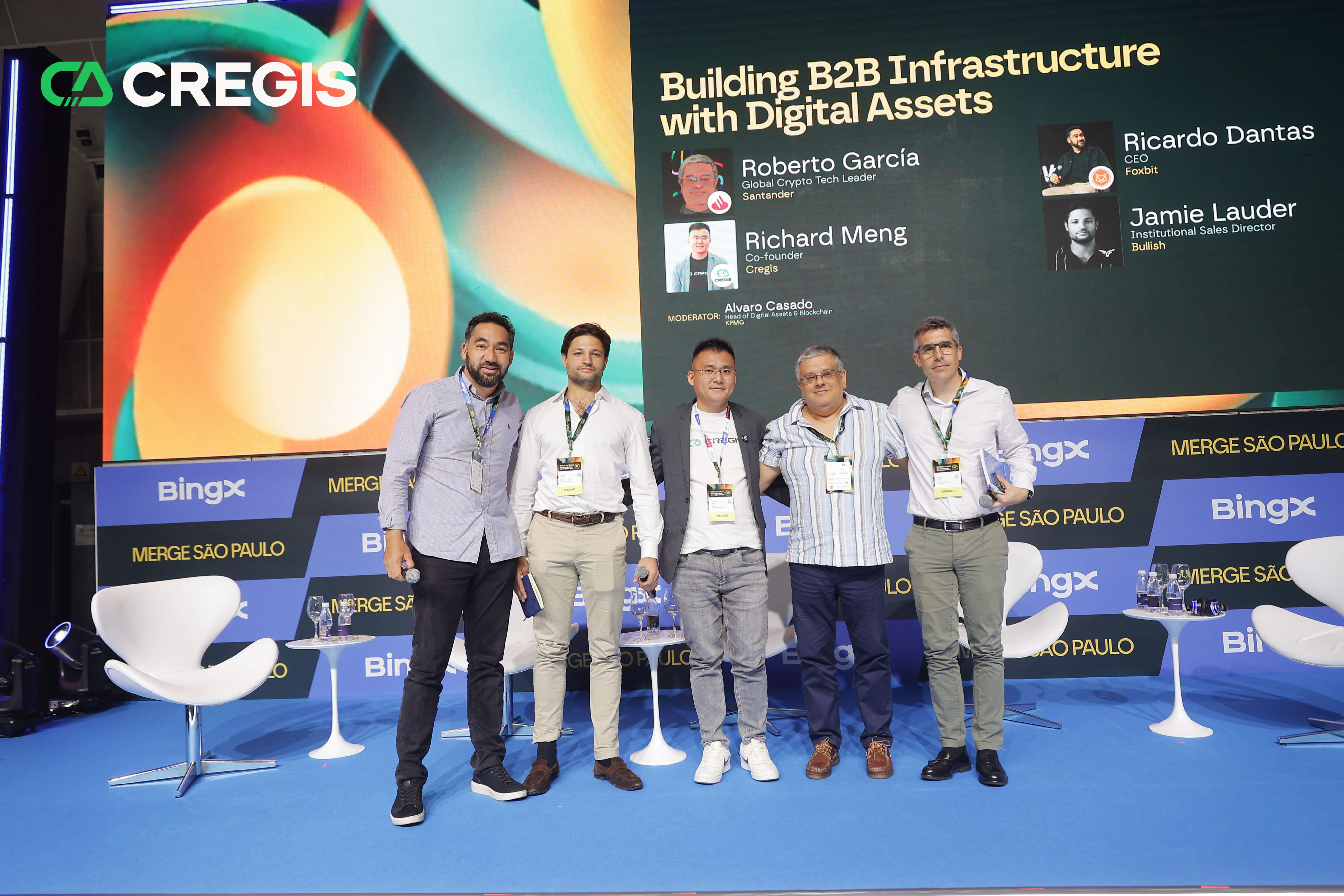
São Paulo, Brazil – The MERGE São Paulo 2026 summit, Latin America’s premier digital asset and Web3 event, recently concluded in São Paulo. Enterprise blockchain infrastructure provider Cregis attended as a Silver Sponsor, deepening its presence in the Latin American market through panel discussions, industry exchanges, and live demonstrations.
Over the two-day event, Cregis showcased its enterprise solutions, including institutional wallets, self-custody options, stablecoin payment engines, and Web3 business networks. The team engaged with local regulators, financial institutions, and partners to explore real-world applications of digital assets in cross-border payments, corporate settlements, and financial infrastructure.
Richard Meng, Co-Founder of Cregis, participated in two core panels, sharing insights on institutional-grade digital asset infrastructure, custody security, and stablecoin payment trends. He highlighted that in 2025, B2B transactions processed through the Cregis Payment Engine tripled year-on-year, with total cross-border volume reaching $10 billion—a surge driven by cross-border traders, payment providers, and market makers seeking efficient stablecoin settlement.
Institutional Custody as the Backbone of Digital Asset Operations
On the panel “Building B2B Infrastructure with Digital Assets”, Richard emphasized that custody is no longer just a service—it is the lifeblood of the industry. “Custody isn’t part of the business; it is the business. Like a bank’s core ledger, any failure in custody can halt operations entirely,” he said.
He outlined three critical capabilities for institutional-grade custody:
- Programmable access control: Multi-signature approvals and tiered permission management
- Transparency and auditability: On-chain transactions aligned with enterprise accounting systems
- Regulatory-compliant infrastructure: Long-term stability under clear regulatory frameworks
Cregis is also pursuing a custody license with Dubai’s VARA to strengthen its global compliance framework.
Bridging Traditional Finance and On-Chain Operations
Richard noted that enterprise challenges often stem not from technology, but from operational gaps between traditional financial systems and blockchain networks. He shared two examples:
A bank spent nearly two years developing an in-house digital asset system, but slow progress due to underestimated complexities in key management and security architecture. Integrating Cregis infrastructure enabled a full rollout in just months.
A payment provider experienced transaction failures due to insufficient wallet gas fees—an operational friction point unseen in traditional finance.
“Traditional accounting tracks debits, credits, and ledgers. On-chain systems track hashes and gas fees. Enterprises need an infrastructure layer to connect both worlds,” Richard explained. By automatically mapping on-chain transactions to enterprise accounting, Cregis reduces operational complexity.
He added, “The most immediate benefit of adopting digital assets is simple: saving time and cost. When cross-border settlements drop from 3–5 days to seconds, that efficiency directly translates into competitive advantage.”
Latin America: Stablecoins as a Cross-Border Trade Tool
On the panel “TradFi + DeFi: Building Institutional-Grade Products”, Richard shared his observations on the Latin American market. Over the past two years, Cregis has engaged with many cross-border payment companies serving the region. Increasingly, Latin American buyers are requesting stablecoin settlements in trade with Chinese suppliers.
“For buyers, stablecoins mean faster settlement, lower fees, and more stable value storage. These real business needs are driving adoption in cross-border trade,” he said.
Cregis now serves over 50 corporate clients in Latin America, with a strong presence in Brazil. Richard confirmed plans to deepen partnerships with local payment providers, fintech firms, and Web3 ecosystem players.
Industry Trends: Institutional Demand Reshaping Infrastructure
In his closing remarks, Richard highlighted a key trend: as banks, brokers, and payment providers enter the digital asset space, the focus is shifting from technology concepts to operationally robust financial infrastructure.
“Most institutions aren’t focused on decentralization—they care about having professional support when issues arise,” he explained. Security architecture, compliance, and accountable service frameworks are now top priorities. As regulation matures, digital asset adoption is evolving from being innovation-driven to institutionally infrastructure-driven.
This shift underscores the need for infrastructure that balances blockchain efficiency with the accountability and compliance mechanisms of traditional finance.
Accelerating Enterprise Adoption in Latin America
With institutionalization of digital assets on the rise, enterprises increasingly demand efficient and secure global capital management. In Latin America, this need is especially pronounced, driven by active cross-border trade and a rapidly growing fintech ecosystem.
“Institutions care less about crypto ideology and more about professional support to keep operations safe and compliant,” Richard emphasized. Enterprise-grade digital asset infrastructure enables faster, more controllable global capital flows, redefining cross-border trade and international funds management.
Through its participation at MERGE São Paulo 2026, Cregis strengthened collaborations with Latin American financial institutions, payment providers, and Web3 ecosystem partners. Moving forward, Cregis aims to leverage its licensed compliance framework, institutional-grade technology, and local partnership network to expand enterprise digital asset adoption across the region.
關於Cregis
Cregis成立於2017年,總部位於香港,是一家面向企業的數字資產基礎設施平台。過去九年間,Cregis已服務全球50多個國家和地區的4,000餘家企業客戶,涵蓋加密交易所、金融科技公司、支付服務商、數字銀行、經紀商及Web3企業等機構。
圍繞企業數字資產運營需求,Cregis構建了覆蓋錢包基礎設施(WaaS)、資金流編排(Rails)及合規託管能力(Custody)的產品體系,幫助企業完成從資產存放與控制、資金流轉與運營,到治理與合規管理的完整閉環。
其中,核心產品 Wallet-as-a-Service 和 Payment Engine 已廣泛應用於企業級數字資產運營場景。隨著數字資產基礎設施需求持續全球化,Cregis始終專注於一件事:幫助企業以更強控制力、更低運營複雜度和更完善的合規能力使用數字資產。