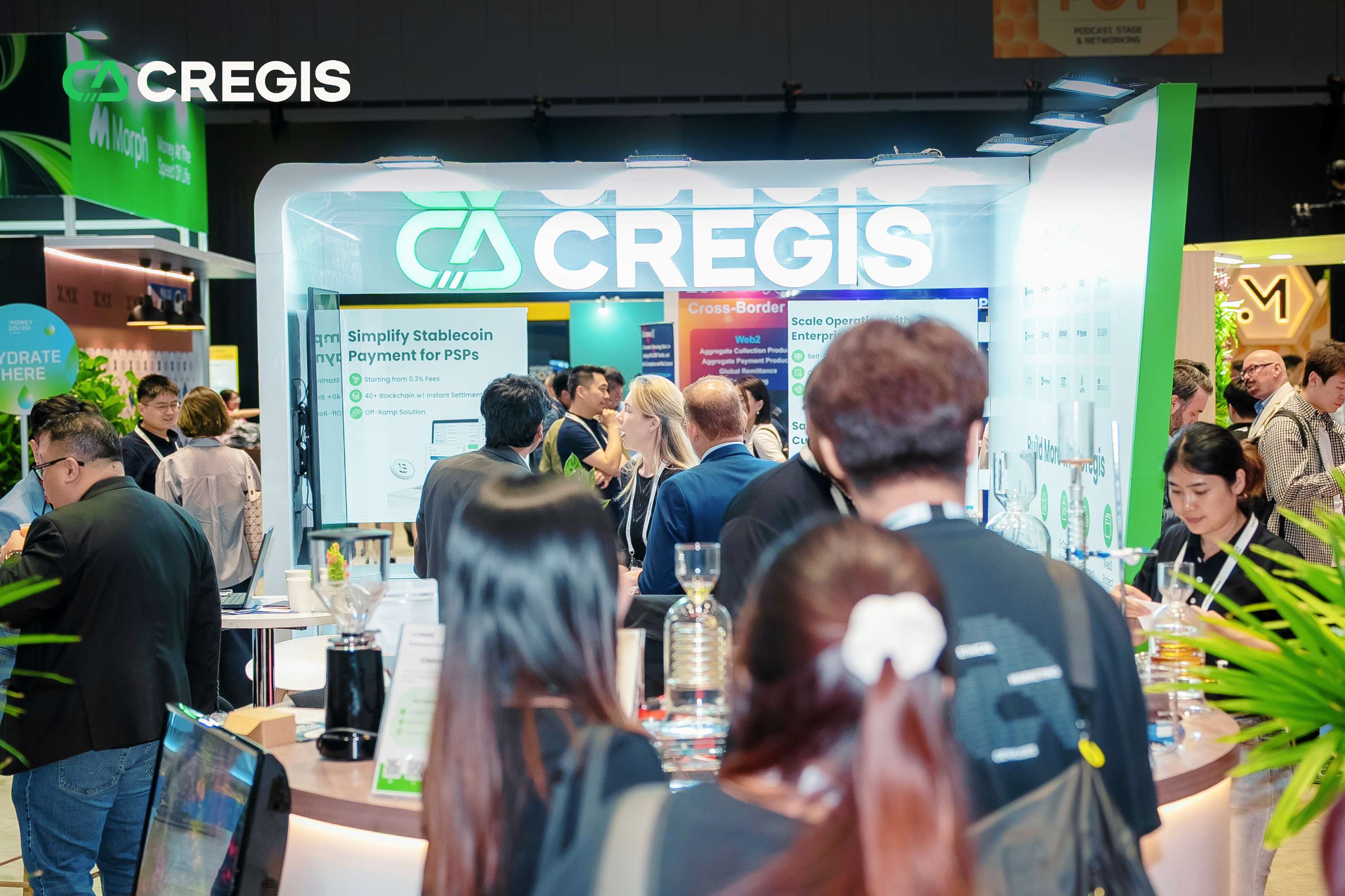
From April 21 to 23, 2026, at Money20/20 Asia 2026—one of the most influential fintech events in the Asia-Pacific region—Cregis participated as an exhibitor at Booth 6001. The conference brought together industry leaders to discuss key themes such as payment innovation, cross-border settlement, digital assets, and regulatory developments. During the event, Cregis presented its comprehensive digital asset infrastructure solutions tailored for enterprises and financial institutions, while engaging in in-depth conversations with participants from banks, payment providers, fintech companies, and Web3 organizations.
Advancing Payment Infrastructure
Throughout the event, the Cregis team highlighted its end-to-end capabilities in on-chain payments and digital asset management, with a focus on enterprise payment and treasury needs. As stablecoins and blockchain technologies increasingly move into real-world applications, enterprise priorities are shifting from simply supporting crypto assets to enabling efficient, secure, and controllable fund flows.
Cregis offers a unified infrastructure that supports multi-chain and multi-asset management, adaptable to a wide range of use cases including cross-border trade settlement, merchant payments, and corporate treasury operations. By ensuring both security and compliance, the platform enables more efficient global fund movement and greater transparency in settlement processes.
Richard, Co-Founder of Cregis, commented during the event: “Today, the key challenge for enterprises is no longer whether to enter the digital asset space, but how to build a fund management system that balances efficiency, security, and compliance. Through our infrastructure, we aim to help businesses operate more effectively in an increasingly complex global payments landscape.”
A New Cross-Border Payment Paradigm Driven by Stablecoins
Stablecoins and on-chain payments emerged as central topics at this year’s conference. As more financial institutions and payment providers explore the use of digital assets in cross-border settlement, stablecoins are becoming a critical bridge between traditional finance and the crypto economy.
During the event, Cregis engaged with various industry partners to discuss practical applications of stablecoins in cross-border trade, enterprise settlement, and treasury management. Compared to traditional cross-border payment rails, stablecoin-based settlement offers clear advantages in efficiency, cost, and transparency. At the same time, it raises higher requirements for underlying infrastructure, particularly in areas such as secure custody, fund monitoring, and regulatory compliance.
Engaging Industry Leaders: Exploring the Future Evolution of Finance in Asia
Beyond its presence on the exhibition floor, Cregis co-hosted a side event titled The Reserved Table: Redefining Asia's Future of Settlements alongside Tether, WIDTH, StraitsX, and PlatON. The event brought together key players across payments, stablecoins, and cross-border settlement to explore the future trajectory of financial infrastructure in Asia.
At the event, Tannie, Head of Southeast Asia at Cregis, joined a panel discussion themed “A New Standard of Value: Stablecoins, Settlement & the New Money Stack”, where he shared insights from frontline enterprise use cases.
Tannie noted that the market still tends to view stablecoins primarily as a “product”, such as a yield-generating tool or trading instrument. However, in real-world business scenarios, stablecoins are increasingly evolving into foundational infrastructure. For exchanges, payment providers, and cross-border enterprises, the focus is no longer on yield, but on critical operational questions: how to enable real-time global settlement, how to manage liquidity across regions, and how to reduce reliance on traditional banking systems.
Looking ahead, Tannie emphasized that the deeper significance of stablecoins lies in their ability to fundamentally reshape how enterprises manage capital. Within an infrastructure-driven stablecoin framework, businesses can achieve:
- Policy-based approval and signing mechanisms for fund movements
- Real-time on-chain reconciliation and automated settlement
- A unified liquidity view across multiple chains and wallets
- 24/7 uninterrupted treasury operations
This shift signals that stablecoins are not merely replacing traditional payment rails—they are driving enterprises to transition from conventional financial workflows toward a more programmable, automated “next-generation operating system for capital.”
From Payment Capabilities to Global Financial Connectivity
As stablecoins, on-chain payments, and enterprise-grade asset management systems continue to mature, a more efficient, transparent, and globally connected financial network is taking shape.
Richard noted: “In the coming years, as the convergence between traditional finance and Web3 accelerates, demand for robust digital asset infrastructure will continue to grow. Cregis aims to be a key enabler in this transition, providing enterprises with secure, scalable, and reliable foundational capabilities.”
Looking ahead, Cregis will continue to enhance its product offerings across custody, payments, and asset management. By focusing on real-world business needs, the company is committed to building a more comprehensive digital asset infrastructure, empowering global enterprises to improve efficiency, manage risks, and achieve sustainable growth in the next generation of financial systems.
關於Cregis
Cregis成立於2017年,總部位於香港,是一家面向企業的數字資產基礎設施平台。過去九年間,Cregis已服務全球50多個國家和地區的4,000餘家企業客戶,涵蓋加密交易所、金融科技公司、支付服務商、數字銀行、經紀商及Web3企業等機構。
圍繞企業數字資產運營需求,Cregis構建了覆蓋錢包基礎設施(WaaS)、資金流編排(Rails)及合規託管能力(Custody)的產品體系,幫助企業完成從資產存放與控制、資金流轉與運營,到治理與合規管理的完整閉環。
其中,核心產品 Wallet-as-a-Service 和 Payment Engine 已廣泛應用於企業級數字資產運營場景。隨著數字資產基礎設施需求持續全球化,Cregis始終專注於一件事:幫助企業以更強控制力、更低運營複雜度和更完善的合規能力使用數字資產。