What is Anychain?
Anychain is a Rust library designed to simplify the development and implementation of multi-chain wallets. Aaron discussed the broad scope of blockchain technology and highlighted the complexities of dealing with multiple programming languages and technologies. For example, different blockchain projects may be written in Go, C, and other languages, each with a different structural approach such as Bitcoin’s UTXO model or Ethereum’s EVM account model.
For developers, if they are working solely with existing blockchain applications, the task is straightforward. However, in many business scenarios like developing a blockchain game, there could be requirements to embed applications in browsers or build various types of transactions. This necessitates a deep understanding of the underlying protocols and APIs. Additionally, the need for cross-platform compatibility, such as Android, iOS, and PC implementations, adds to the cost, hampering blockchain ecosystem development. To address these issues, the Anychain team abstracted basic functionalities into a library, choosing Rust as their implementation language for its safety and efficiency. The library is running smoothly, and its features will be incorporated into upcoming versions.
Advantages of Using Rust for Blockchain Development?
Ian Xu believes that Rust offers two primary benefits: safety, particularly regarding memory safety, and high performance comparable to C++. Furthermore, Rust excels in concurrent and asynchronous processing. Although currently, fewer developers might be using Rust due to its steeper learning curve, Ian Xu is confident that as the blockchain industry matures, Rust will garner more attention and usage.
The Value of Anychain and How it Helps Developers Build More Complex Applications
Aaron delved into how developers could choose to interact with blockchains. For instance, in developing a blockchain-based online game, developers may prefer users to interact via wallets like MetaMask. However, the server-side interaction with the blockchain can often be more complex. Anychain aims to assist developers in building more intricate applications.
Aaron pointed out that as the industry matures, there will be an increasing demand for native blockchain calls for enterprise-level requirements. Anychain provides key support for solving these challenges by serving as a tool that can facilitate complex interactions with native chains.
Why is Rust Advantageous as a Wallet Development Language?
Dim1tp1, sharing from his front-line development experience, listed several advantages of Rust for wallet development:
- Memory Safety: Rust’s compiler can effectively prevent issues like dangling pointers, null pointer dereferences, and buffer overflows at compile-time, significantly enhancing code security.
- Efficiency: The machine code generated by Rust’s compiler is highly efficient, especially when operating in release mode.
- Cross-Platform Support: Thanks to Cargo, Rust offers strong cross-platform support, making it easier for developers to configure multiple target platforms and run the code directly on those platforms.
- Concurrency Safety: While many praise Rust for its concurrency, Dim1tp1 thinks its strength is not necessarily better than Go but lies in the improvements it has made for concurrency safety compared to languages like C and C++.
The Future of Public Chains, Blockchain Ecosystem, and the Importance of Cross-Chain Technology
Crystal believes that the blockchain industry is blossoming with a multitude of public chains. Her team supports multi-chain asset verification, allowing users to prove their various assets across different chains, including tokens and NFTs. This not only aims to support existing chains but also aspires to accommodate more in the future.
The intention behind this is to prepare for the rise of apps that support multiple chains. As more public chains emerge, they aim to serve as facilitators, allowing users to hold and verify different NFTs or tokens on various chains (including Layer 1 and Layer 2) and apply them in different scenarios.
More importantly, their efforts are geared towards lowering the entry barrier for developers into the Web3 world, making it easier for them to dive into this innovative and opportunistic landscape.
Summary
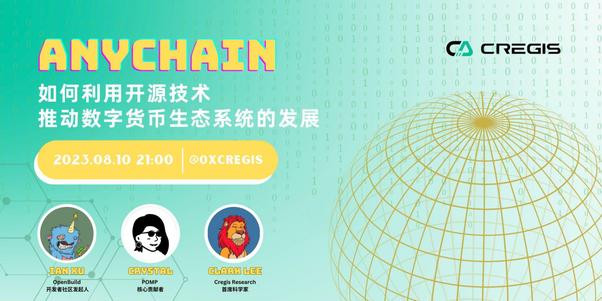
In this Twitter Space event, the guests shared their insights and experiences in blockchain and open-source technology. They generally agreed that Rust has significant advantages in blockchain development, including memory safety, efficiency, cross-platform support, and concurrency safety. Anychain, as a library, simplifies the development and implementation of multi-chain wallets and helps lower the barrier for developers entering the Web3 world. As the number of public chains continues to increase, the value and importance of the blockchain ecosystem and cross-chain technology are set to rise accordingly.
About Cregis
Founded in 2017 and headquartered in Hong Kong, Cregis is an enterprise digital asset infrastructure platform.
Over the past nine years, Cregis has served more than 4,000 businesses across 50+ countries and regions, including crypto exchanges, fintech companies, payment providers, digital banks, brokers, and Web3 businesses.
Cregis provides a three-layer infrastructure stack spanning Wallet Infrastructure, Fund Flow Orchestration, and Custody Capabilities, enabling enterprises to manage the full lifecycle of digital assets, from asset control and fund operations to governance and compliance.
Its core products, Wallet-as-a-Service (WaaS) and Payment Engine, are widely used across enterprise digital asset use cases. As demand for digital asset infrastructure continues to expand globally, Cregis remains focused on helping businesses operate digital assets with greater control, lower operational complexity, and stronger compliance readiness.