Cregis co-hosted the Institutional Onchain Finance Summit 2026 in Singapore on October 6 during TOKEN2049 Week, alongside global payment solutions provider FOMO Pay, stablecoin payment infrastructure provider Stable, and compliance and risk intelligence platform Width. The event brought together representatives from financial institutions, payment companies, stablecoin businesses, digital asset infrastructure providers and cybersecurity firms to discuss how institutions are putting onchain finance into practice.
Across the keynotes and panel discussions, speakers examined the operational requirements behind institutional adoption. As businesses incorporate stablecoins and digital assets into payments, treasury and other financial activities, they need reliable infrastructure, clear controls and workable connections to existing financial systems. The discussions focused on how these requirements can be met across markets with different payment networks and regulatory frameworks.
Building the Infrastructure for Business on Chain
Cregis COO Jason Ma opened the summit with “A Solid Foundation for Your Business on Chain,” a keynote on the infrastructure businesses need to bring digital assets into everyday operations.
He introduced Cregis’s product framework across Wallet-as-a-Service (WaaS), funds flow orchestration (Rails) and compliant custody capabilities (Custody). These capabilities address different requirements for asset control, payments, operational management and institutional governance.
The presentation explored how businesses can integrate wallets, blockchain transactions and funds management into their existing workflows. As digital assets find applications in collections, disbursements, treasury transfers and cross-border business, enterprises need systems that connect onchain activity to the processes their finance and operations teams already use.
That requirement carried into the summit’s payment discussions: how can businesses move funds across markets efficiently while maintaining visibility and control?
Stablecoin Payments: Cost, Speed and Predictability
The “Stablecoins & Cross-Border Payments” panel was moderated by Chiara Munaretto, Co-Founder of Stable Insider, with Leandro Noel, Founder & COO of Avenia; Andres Kim, Regional Expansion Lead at Tether; Eddie Hui, Co-President & COO of MetaComp; and Zack Yang, Co-Founder of FOMO Pay.
The panel identified cost, settlement speed and predictability as immediate concerns for businesses making cross-border payments. Traditional transfers can involve several intermediaries, leaving businesses uncertain about fees, arrival times and the status of their funds. Stablecoins offer an alternative settlement method that operates around the clock and allows transfers to be tracked onchain.
The discussion also examined how stablecoins fit alongside domestic payment systems. Andres Kim used South Korea as an example, pointing to cross-border commerce involving K-beauty and K-pop businesses. Local payment networks remain essential in these markets, while stablecoins can help connect them to overseas customers and counterparties and address gaps in the cross-border payment journey.
Leandro Noel approached the issue from the perspective of international expansion. He described stablecoins as a way to establish a shared ledger for global business, allowing companies to manage funds across markets without rebuilding a complete financial infrastructure in every jurisdiction.
For businesses, this places the value of stablecoins within a broader commercial context. Their usefulness depends on how effectively they reduce the cost and complexity of entering markets and connecting payment systems.
In his keynote, “Global Payments, Made Stable,” Stable CEO Brian Mehler discussed the network infrastructure required to support stablecoin payments and global funds movement. He outlined Stable’s approach to reducing intermediary steps and settlement uncertainty in cross-border payments.
The growth of stablecoins also introduces coordination challenges. Zack Yang noted that businesses have often had to manage numerous wallets and payment channels across countries. Stablecoins can simplify parts of this process, but the growing number of stablecoins in 2026 has created further fragmentation across liquidity pools and networks. Connecting these systems is becoming an increasingly important infrastructure requirement.
Bringing Compliance into the Transaction Flow
As stablecoin payments expand, compliance decisions must keep pace with the movement of funds.
Chye Kit Chioh, CEO & Co-Founder of Width, addressed this issue in “The Future of Compliance 2027 and Beyond: AI, Automation, and the Shift to Real-Time Risk Intelligence.” His keynote examined how AI, automation and real-time risk monitoring can change the way businesses manage compliance.
The payments panel explored the same challenge from an operational perspective. A cross-border stablecoin payment may involve domestic payment services, conversion between fiat and stablecoins, and settlement across jurisdictions. Each stage brings its own requirements and responsibilities.
Panelists called for closer cooperation among banks, payment providers and stablecoin businesses, alongside greater regulatory understanding of how these services operate in practice. As transactions become faster, businesses increasingly need risk assessment and compliance controls within the payment workflow, with less reliance on manual reviews after funds have moved.
Security Beyond Smart Contract Audits
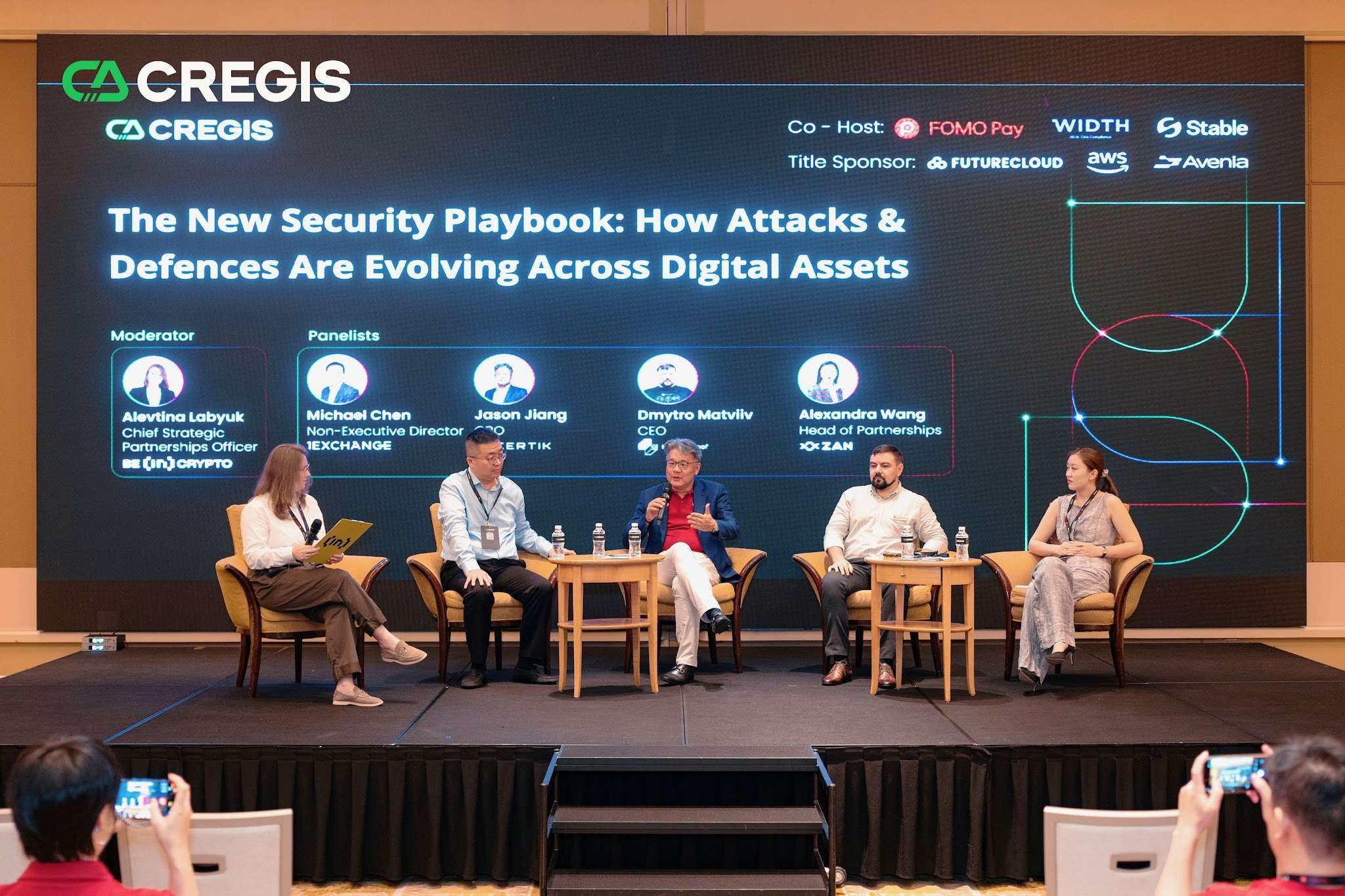
The security panel, moderated by Alevtina Labyuk, Chief Strategic Partnerships Officer at BeInCrypto, examined the risks institutions face when operating with digital assets.
Panelists included Michael Chen, Non-executive Director of 1exchange; Jason Jiang, Chief Business Officer of CertiK; Dmytro Matviiv, CEO of HackenProof; and Alexandra Wang, Head of Partnerships at ZAN.
The discussion treated smart contract audits as a baseline requirement. An audit assesses code at a particular point in time, while institutions also face risks arising from key management, employee access, transaction signing, external providers and incident response.
Jason Jiang described audits as the first step in a continuing security process that also requires monitoring, anomaly detection and the ability to trace funds. Michael Chen focused on internal controls: who can authorize a transaction, how many signatures are required, and how assets should be allocated between hot and cold wallets.
Vendor governance was another concern. Institutions may rely on separate providers for wallets, custody, payments and security services, creating dependencies that need to be understood and managed. Dmytro Matviiv emphasized that businesses retain responsibility for their operations and assets even when several external providers are involved. Clear provider responsibilities, defined risk boundaries and plans to limit losses in a worst-case scenario are therefore essential.
Defining Authority and Accountability for AI Agents
The security discussion also considered the use of AI agents in trading, treasury management and other financial activities. AI can help detect anomalies and support decision-making and execution, but irreversible actions such as funds transfers require clearly defined authority and accountability.
Michael Chen discussed the potential for AI-assisted financial transactions, with immutable authorization records for critical actions. He also pointed to zero-knowledge proofs as a possible way to support institutional traceability while limiting unnecessary disclosure.
The discussion extended to what happens when a transaction goes wrong. Institutions need to establish responsibility, investigate activity and pursue funds recovery where possible. These processes are well established in traditional finance and remain an important area of development for onchain financial systems.
For institutional users, transaction visibility must be supported by practical procedures for dispute resolution and incident handling.
Extending Onchain Infrastructure to Financial Markets
The summit’s closing keynote broadened the discussion from payments and operations to institutional financial markets.
In “Injective’s Institutional Stack,” Eric Chen, CEO & Co-Founder of Injective, presented the company’s infrastructure approach across institutional access, compliance, asset tokenization and financial market applications.
The presentation covered access controls, programmable compliance, real-world assets and onchain markets. These capabilities address the requirements for bringing a wider range of financial activities onto blockchain infrastructure.
Across the summit, the discussions connected business wallets and payment operations with stablecoin settlement, real-time compliance, security governance and institutional markets. Together, they reflected the work required to turn individual onchain use cases into systems
About Cregis
Founded in 2017 and headquartered in Hong Kong, Cregis is an enterprise digital asset infrastructure platform.
Over the past nine years, Cregis has served more than 4,000 businesses across 50+ countries and regions, including crypto exchanges, fintech companies, payment providers, digital banks, brokers, and Web3 businesses.
Cregis provides a three-layer infrastructure stack spanning Wallet Infrastructure, Fund Flow Orchestration, and Custody Capabilities, enabling enterprises to manage the full lifecycle of digital assets, from asset control and fund operations to governance and compliance.
Its core products, Wallet-as-a-Service (WaaS) and Payment Engine, are widely used across enterprise digital asset use cases. As demand for digital asset infrastructure continues to expand globally, Cregis remains focused on helping businesses operate digital assets with greater control, lower operational complexity, and stronger compliance readiness.