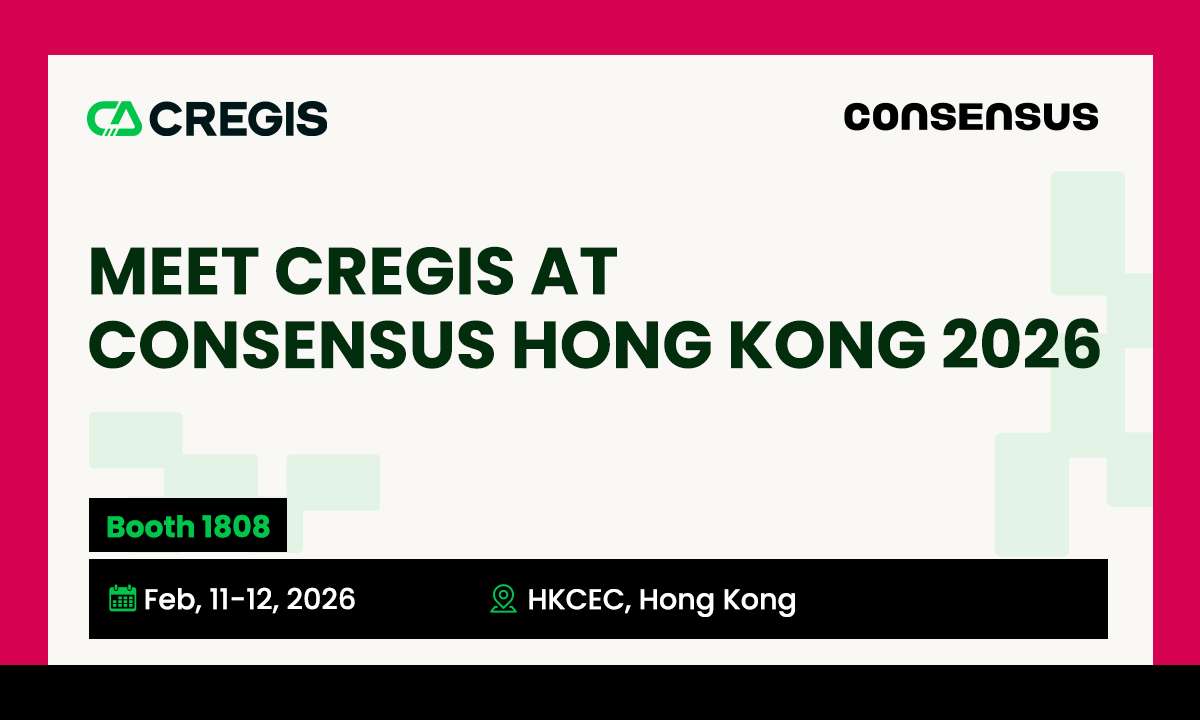
Hong Kong - As stablecoins, AI, and automated systems increasingly enter real-world finance and payments, digital asset infrastructure is approaching a critical inflection point. Enterprise blockchain infrastructure provider Cregis has announced it will participate in Consensus Hong Kong 2026, taking place February 10–12, where it will engage with industry peers on the evolving role of stablecoins, enterprise asset management, and emerging technologies in financial systems.
Attendees can visit Booth 1808 at the Hong Kong Convention and Exhibition Centre to explore Cregis’ infrastructure offerings, including its crypto payment engine, self-custody MPC wallet infrastructure, and enterprise-grade self-custody solutions. According to the team, the event represents not just an industry appearance, but an opportunity to observe and contribute to a deeper question: how crypto assets can meaningfully integrate into real financial systems.
Digital Assets Enter Business Operations
Over the past few years, much of the industry conversation has centered on issuance and trading. But as institutional participation accelerates, the focus is shifting toward a more complex challenge: how digital assets are operated in secure, compliant, and efficient ways.
As financial institutions and payment companies begin using on-chain assets in real business workflows, asset management is no longer just about private key security. It becomes a system-level problem involving multi-party coordination, permission design, auditability, and risk governance.
Against this backdrop, Cregis plans to focus on:
- The security and coordination requirements of enterprise asset management in stablecoin and payment use cases
- How permissions, accountability, and auditability should function across multi-team, multi-system operations
- How automation and intelligent systems are redefining the requirements for underlying asset infrastructure
Stablecoins Move to the Center of Financial Infrastructure
Consensus Hong Kong 2026’s agenda reflects a broader industry shift. Compared with previous years, stablecoin-related discussions have expanded significantly, with the focus moving from whether stablecoins are viable to how they scale.
Topics around cross-border payments, settlement efficiency, liquidity movement, and regulatory frameworks are increasingly seen as the connective layer between crypto-native systems and traditional finance. For many industry participants, this marks a transition: crypto assets are no longer viewed primarily as speculative instruments, but as emerging components of financial circulation infrastructure.
AI, Automation, and Crypto Enter the Execution Phase
Beyond stablecoins, the convergence of AI, robotics, and crypto has emerged as another defining theme at Consensus 2026.
Unlike earlier years dominated by conceptual narratives, discussions are increasingly grounded in practical questions: How can asset security be ensured when AI agents execute strategies autonomously? How should responsibility and authority be defined when automated systems participate in economic activity? If enterprise systems become key economic actors, how must financial infrastructure evolve?
Underlying these questions is a growing consensus: technological convergence is moving closer to real deployment, not just storytelling.
The Debate Has Shifted
Disagreements around the future of crypto adoption remain. But the nature of the debate has changed. At Consensus Hong Kong 2026, the discussion is less about whether crypto will be adopted, and more about:
- What form adoption will take
- Whether infrastructure will become invisible to end users
- Who bears systemic risk, and who defines operational rules
In this context, the maturity of infrastructure is emerging as a key determinant of where the industry goes next.
Observing and Participating in an Inflection Point
The industry is transitioning from “exploring possibilities” to “building durable systems.” The evolving themes at Consensus Hong Kong 2026 are a clear signal of that shift.
As stablecoins, digital assets, and intelligent systems move deeper into real financial and commercial environments, the resilience, controllability, and compliance-readiness of infrastructure will determine how far adoption can go. During the event, Cregis will engage with participants across payments, financial institutions, and Web3, while continuing to focus on the evolution of enterprise digital finance infrastructure.
Cregis aims to provide enterprises with end-to-end digital asset management and operational infrastructure. By building security-first, flexible, and compliance-oriented systems, the company seeks to abstract complex onchain operations into standardized solutions that enterprises can easily integrate and manage — helping institutional clients navigate this industry transition with confidence.
关于Cregis
Cregis成立于2017年,总部位于香港,是一家面向企业的数字资产基础设施平台。过去九年间,Cregis已服务全球50多个国家和地区的4,000余家企业客户,涵盖加密交易所、金融科技公司、支付服务商、数字银行、经纪商及Web3企业等机构。
围绕企业数字资产运营需求,Cregis构建了覆盖钱包基础设施(WaaS)、资金流编排(Rails)及合规托管能力(Custody)的产品体系,帮助企业完成从资产存放与控制、资金流转与运营,到治理与合规管理的完整闭环。
其中,核心产品 Wallet-as-a-Service 和 Payment Engine 已广泛应用于企业级数字资产运营场景。随着数字资产基础设施需求持续全球化,Cregis始终专注于一件事:帮助企业以更强控制力、更低运营复杂度和更完善的合规能力使用数字资产。